Imagine standing on top of a 12-foot extension ladder, balancing a heavy sheet of exterior siding with one hand, while your other hand frantically fumbles around your back pocket for your framing hammer. It isn’t there. You shift your weight, your heart skips a beat, and you look down to see your tool lying in the grass below. That is a 20-minute waste of energy, a major safety hazard, and a classic example of poor tool ergonomics.
In my 10-plus years of managing home renovation sites and swinging a hammer myself, I’ve noticed that beginners and intermediates often focus entirely on power tools and heavy machinery when trying to improve their efficiency. But real mastery of the craft is found in the details of how you carry your gear. If you want to work faster, avoid chronic joint pain, and keep your workspace safe, integrating a dedicated hammer holder loop into your daily setup is one of the most effective upgrades you can make.
The Hidden Cost of Micro-Movements in Home Improvement
Let’s look at the numbers and the biomechanics. An average carpenter or dedicated DIYer reaches for their hammer dozens, sometimes hundreds of times a day. If your tool is tucked into a deep pouch or an unreinforced pants pocket, you are forced to perform a complex, awkward micro-movement every single time you retrieve it.
Think of your body like a high-performance engine. Every inefficient movement is a misfire that wastes fuel and wears down the moving parts. Reaching too far back or bending your wrist at an odd angle to yank a stuck claw hammer out of a tight pocket puts unnecessary strain on your rotator cuff and wrist tendons. Over a long project, these repetitive micro-strains accumulate into genuine fatigue and overuse injuries like tendonitis.
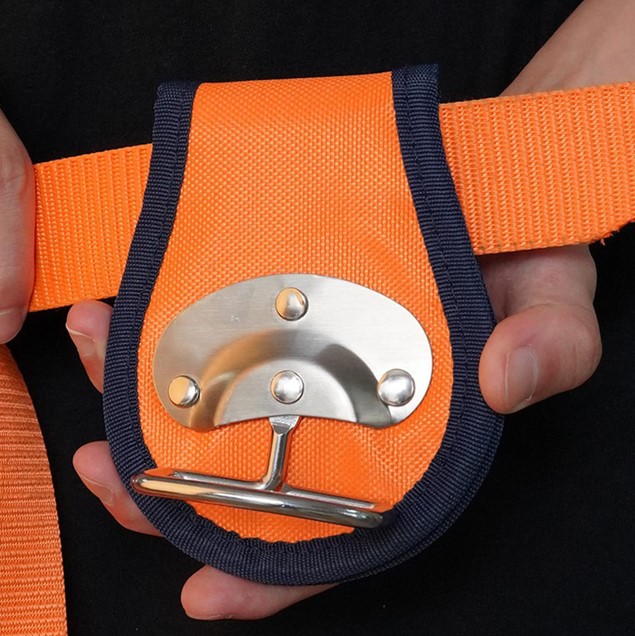
A well-designed hammer holder loop solves this by standardizing the tool’s location. It keeps the handle suspended at a predictable, natural dropped-hand height. Your hand falls directly onto the grip without you ever having to look down, turning a clumsy search into pure muscle memory.
Anatomy of an Ergonomic Hammer Holder Loop: Leather vs. Steel vs. Fabric
Not all loops are created equal. When you are looking to invest in tool belts or modular attachments, understanding the technical differences in materials will save you both money and frustration down the line.
| Material Type | Rigidity & Shape Retention | Swing & Movement | Best Used For |
| Rigid Steel Cradle | Maximum; always stays wide open | High swing; pivots on a hinge | Heavy framing hammers, high-frequency use |
| Heavy-Duty Leather | Medium; breaks in over time | Low swing; molds to the handle | Finish carpentry, traditional setups |
| Ballistic Nylon / Webbing | Low; can flatten when empty | Medium swing; ultra-lightweight | Light maintenance, roofers looking for minimal weight |
The Steel Cradle Advantage
For intermediate workers moving into faster paced framing or deck building, I almost always recommend a metal loop fixed to a leather or synthetic base. Because the steel loop retains its open shape perfectly, you can drop the hammer back into its home blindly. You don’t have to fight a collapsed fabric loop with your fingertips while your eyes are focused on holding a workpiece steady.
The Swivel vs. Fixed Dilemma
Some premium hammer holder loop designs feature a swivel hinge. This allows the hammer to hang vertically regardless of whether you are crouching, climbing, or sitting. If you spend a lot of time on your knees doing flooring or low-level electrical work, a swivel loop prevents the handle from digging into the back of your leg or pushing the hammer up and out of the holder entirely.
Pro-Tips for Tuning Your Tool Belt Layout
Having the right gear is only half the battle; you also need to position it correctly to maximize operational ergonomics.
          [Your Front / Buckle]
         /                      \
   [Tape Pouch]            [Nail Pouch]
       │                        │
  (Non-Dominant)            (Dominant)
       │                        │
       └─────── [Behind Hip] ───┘
                    │
         ★ [Hammer Holder Loop] ★
💡 Pro-Tip: The “Behind-The-Hip” Sweet Spot
Never place your loop directly on the side of your hip bone. If you trip or take a misstep, falling directly onto a solid steel hammer head can cause severe bruising or hip displacement. Instead, slide the loop just behind the hip toward your glutes. This keeps the tool out of the way of your thigh when walking or climbing stairs, but still comfortably within arm’s reach.
Balance the Load
If your hammer sits on your dominant side, ensure your non-dominant side carries an equivalent counter-weight—like your tape measure, speed square, and fasteners. An unbalanced tool belt forces your spine to curve slightly sideways to compensate, which is a prime trigger for lower back pain after a eight-hour shift.
Avoid These Common Beginner Mistakes
Throughout my career, I’ve seen plenty of apprentices make simple mistakes with their gear that completely cancel out the ergonomic benefits of their setup.
-
The Leg-Slapper Effect: If your loop is mounted too low on an overly long tool apron, the handle of your hammer will slap against your knee or thigh with every step you take. This is incredibly annoying, ruins your stride, and can cause bruising over a long day. Keep the loop high enough so the handle stays parallel to your upper thigh.
-
Neglecting Handle Material Friction: A rubber-gripped hammer provides excellent shock absorption for your hands, but it can grab and stick against leather or fabric loops. If you use a high-traction rubber grip, opt for a smooth, polished steel loop to ensure a clean, friction-free draw.
-
Ignoring the Handle Flares: Before you purchase a modular loop, check the pommel (the flared bottom end) of your favorite hammer. Some specialty options have extra-wide flared bases that can jam inside narrow metal loops. Always test the fit to guarantee a smooth drop-and-draw cycle.
Elevating Your Workflow Beyond the Basics
Upgrading to a dedicated, high-quality hammer holder loop is about much more than just carrying a tool around your waist. It is a fundamental shift in how you approach your workspace. By treating your body like an efficient machine and minimizing unnecessary movements, you save your energy for the work that actually matters—cutting straight lines, driving clean nails, and building things that last.
What does your current tool belt setup look like, and how do you handle your heavy hand tools when working at heights? Let’s talk about your favorite gear modifications in the comments below!