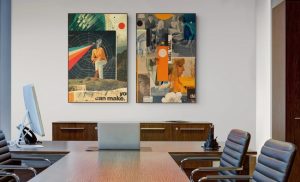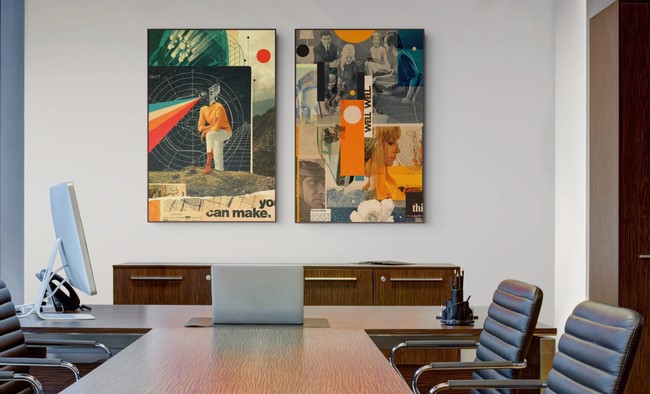
A few months ago, I walked into the newly finished home office of a high-level executive client. He had spent upwards of $15,000 on custom walnut cabinetry, an ergonomic leather chair, and state-of-the-art lighting. Yet, standing in the doorway, the room felt strangely hollow and impersonal—almost like an unscripted movie set.
The culprit? Behind his main desk sat a blank, imposing drywall expanse that rendered every high-stakes video call feeling cold and detached. Within two days, we curated and mounted a large-scale textured canvas that subtly echoed his company’s brand identity through muted earth tones and sharp geometric lines.
The transformation was immediate. His virtual screen background went from sterile to authoritative, completely shifting how clients perceived his executive presence. Integrating curated abstract wall art into a professional workspace is not just a decorative afterthought; it is a strategic investment in environmental branding, psychological focus, and spatial acoustics.
The Psychology of Form and Color: Why Abstract Art Works
Unlike figurative portraiture or literal landscape photography, non-representational art allows viewers to project their own thought processes onto a canvas. In a corporate or home executive setting, this open-ended visual dialogue stimulates creative problem-solving while reinforcing brand values without resorting to aggressive corporate logos.
Strategic placement of abstract wall art leverages color theory and geometric harmony to subconsciously communicate stability, innovation, or agility to visiting clients and virtual attendees.
+-----------------------------------------------------------------------+
|                   COLOR & GEOMETRY BRANDING MATRIX                    |
+--------------------------+---------------------+----------------------+
| Visual Element           | Psychological Impact| Recommended Industry |
+--------------------------+---------------------+----------------------+
| Sharp Angular Lines      | Precision & Energy  | FinTech / Engineering|
| Soft Fluid Curves        | Calm & Adaptability | Creative / Consulting|
| Deep Blues & Slates      | Trust & Authority   | Legal / Finance      |
| Warm Ochres & Terracotta | Innovation & Energy | Marketing / Tech     |
+--------------------------+---------------------+----------------------+
Think of abstract art in an executive environment like custom tailoring on a suit. A generic off-the-rack print speaks of routine and compliance, whereas a carefully chosen, dimensionally rich canvas signals precision, intention, and an elevated attention to detail.
Architectural Scaling: Sizing and Proportion Mechanics
The most frequent mistake I observe in executive room design is hanging undersized artwork on expansive focal walls. An undersized canvas makes even a luxurious office look unorganized and disproportionate.
To establish ideal visual balance, your artwork must conform to the Golden Ratio relative to the furniture anchored beneath it.
                 CEILING LINE
                      |
                      v
         +--------------------------+
         |                          |
         |    [ ABSTRACT WALL ART ] |  <-- 60% to 75% of Desk Width
         |                          |
         +--------------------------+
                      |
                      v
             [ EXECUTIVE DESK ]
-
Furniture Anchor Ratio: The total width of your artwork (or gallery grouping) should span roughly 60% to 75% of the total width of the desk, credenza, or sofa below it.
-
Vertical Centerline Rule: Hang single canvases so that the vertical center point sits exactly 57 to 60 inches from the finished floor, which aligns naturally with standard human eye level.
-
Acoustic Mass Considerations: Large stretched canvas art backed by internal acoustic foam act as sound-dampening baffles, significantly reducing room echo during audio calls.
Selecting Materials: Canvas, Glass, and Framing Profiles
Navigating art mediums requires balancing visual presentation with environmental conditions such as direct sunlight, overhead task lighting, and glare.
1. Gallery-Wrapped Stretched Canvas
Stretched linen or cotton canvas offers a rich, tactile surface with zero glare. Thick-textured impasto acrylic paintings add real three-dimensional shadow play under directional spotlighting.
2. Museum Glass and Fine Art Giclée
High-definition fine art prints framed behind anti-reflective museum-grade UV glass preserve paper color integrity while eliminating harsh reflections from surrounding windows and desk lamps.
3. Floating Frame Profiles
Surrounding a stretched canvas with a slim hardwood floating frame (such as matte black, warm walnut, or brushed brass) creates a 1/4-inch shadow gap. This subtle boundary elevates the artwork off the wall surface, framing it as a distinct architectural element.
Step-by-Step Installation: Safe and Flush Wall Mounting
Oversized executive artwork demands structural mounting protocols. Never rely on basic plastic wall anchors or adhesive strips for heavy, framed artwork.
       [ STEP 1 ]             [ STEP 2 ]             [ STEP 3 ]             [ STEP 4 ]
+----------------------+   +--------------+   +----------------------+   +----------------------+
| Sightline Marking &  |-->| Wall Stud    |-->| D-Ring / Cleat       |-->| Mounting, Leveling   |
| Centerline Height    |   | Location     |   | Fastener Torque      |  | & Bumper Placement   |
+----------------------+   +--------------+   +----------------------+   +----------------------+
Step 1: Establishing the Focal Sightline
Measure 58 inches up from the floor along your target wall. Mark this horizontal line lightly with painter’s tape to establish your eye-level centerline.
Step 2: Locating Wall Studs and Selecting Hardware
Use an electronic stud finder to locate structural framing.
-
For pieces under 25 pounds, high-grade heavy-duty wall hangers placed into drywall are sufficient.
-
For heavy wooden-framed or glass-shielded pieces exceeding 30 pounds, use an aluminum French Cleat system anchored directly into at least one wood stud using 2.5-inch wood screws.
Step 3: Fastening and Securing
Attach the frame-side cleat or heavy-duty D-rings securely to the top rear rail of your artwork frame. Drive wall-side fasteners home, checking level alignment with a 2-foot spirit level before fully tightening.
Pro Tip: Stick clear silicone adhesive bumpers onto the two lower rear corners of your artwork frame. This simple step prevents the frame from shifting out of level when doors slam nearby, preserves your wall paint, and maintains a clean 1/8-inch air gap behind the canvas.
Expert Advice: Critical Pitfalls and Pro Guidelines
With over ten years of designing high-end interiors, I’ve seen small curation mistakes ruin the executive feel of an otherwise impeccable workspace.
Hidden Warning: Beware of harsh lighting positioning! Placing bright halogen directional spotlights too close to oil paintings can melt delicate surface varnishes over time, while unshielded daylight causes permanent paper yellowing on unframed prints. Always use cold-LED, UV-free picture lights rated at 2700K to 3000K color temperature.
Keep these core operational principles in mind throughout your curation journey:
-
Mind Your Video Camera Field-of-View: Sit in your executive chair and launch your webcam preview before finalizing your mounting position. Ensure the artwork sits cleanly within the upper two-thirds of your video frame without being obscured by your head or chair back.
-
Maintain Visual Balance: Avoid pairing intense, busy abstract canvases with heavily patterned wallpaper. Pair bold artwork with neutral wall finishes like warm off-white, deep charcoal, or subtle lime wash textures.
-
Match Frame Metals to Room Hardware: Harmonize the frame finish with your office hardware—pair matte black floating frames with modern black door handles, or brushed brass frames with warm wood furniture accents.
Troubleshooting Workspace Curation Issues
If your wall art arrangement feels unbalanced or visually distracting on screen, use this quick troubleshooting matrix to adjust your setup.
+---------------------------------------------------------------------------------+
|                        ARTWORK CURATION TROUBLESHOOTING                         |
+----------------------+--------------------------+-------------------------------+
| Symptom Observed     | Underlying Cause         | Recommended Corrective Action |
+----------------------+--------------------------+-------------------------------+
| Glare on Video Calls | Standard Picture Glass   | Replace with Anti-Reflective  |
|                      | Catching Overhead Lights | Museum Glass or Canvas Medium |
| Art Looks Tiny       | Canvas Width Under 50%   | Group into a triptych or add  |
|                      | of Below Desk Width      | a wider floating frame mat    |
| Colors Look Bleached | Low Color Rendering (CRI)| Upgrade room lighting to high-|
|                      | Bulbs In Office          | CRI (90+) LED bulbs (3000K)   |
| Frame Tilts Constantly| Single Hanging Point    | Use two spaced D-rings or an  |
|                      | On Wall                  | aluminum French Cleat system  |
+----------------------+--------------------------+-------------------------------+
When evaluating artwork under artificial room lighting, ensure your office fixtures offer a high Color Rendering Index (CRI 90+). Low-CRI bulbs distort color tones, turning rich blues into dull grays and muddying fine brushwork details.
Elevate Your Professional Space Today
Curating your workspace with high-impact abstract wall art is far more than a decorative luxury; it is a calculated design strategy that defines your personal brand, enhances room acoustics, and elevates your everyday focus. By selecting the right scale, securing hardware properly, and matching color mechanics to your professional ethos, you craft an environment that inspires confidence and reflects true executive authority.
Are you currently re-designing your executive office or selecting artwork for an upcoming home office upgrade? Drop your questions, wall dimensions, or design ideas in the comments below—I’d love to help you curate your space!