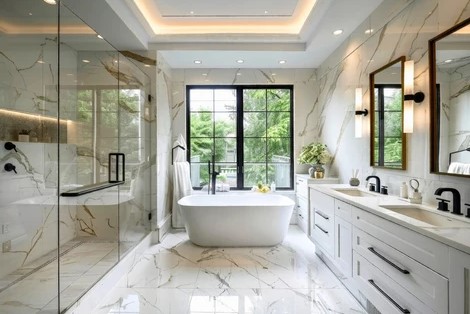
Imagine walking into a newly renovated $2 million master suite. The Italian porcelain tile sparkles, a handcrafted soaking tub sits beneath a crystal chandelier, and the room feels like a five-star spa resort. Then, you turn on the water, and instead of a cascading ribbon of warm water, a weak trickle slowly splashes into the basin. Even worse, touching the slender metal column causes the entire assembly to wobble like a loose fence post.
In my 10-plus years of designing and engineering high-end residential interiors, I have witnessed this exact heartbreak more times than I care to admit. Homeowners and builders routinely spend thousands of dollars on luxury soaking tubs, only to treat the freestanding tub faucet as a basic afterthought.
Yet, in modern luxury bathroom design, this single floor-mounted fixture acts as the architectural anchor. It bridges raw plumbing engineering with high-end aesthetic branding, defining the overall caliber of your master bath.
The Visual Anchor: Why the Freestanding Tub Faucet Defines Luxury Bath Design
A freestanding soaking tub naturally serves as the center of gravity in a luxury bathroom. However, without a commanding floor-mounted tub filler standing beside it, even the most expensive tub can look isolated or unfinished within a vast floor layout.
Think of a freestanding tub faucet as the analog dashboard clock in a handcrafted luxury sports car. It is not merely a utility designed to fill a vessel with water; it is a tactile statement of precision engineering, material substance, and intentional design.
-
Architectural Sculpting: A floor-mounted faucet breaks up vast horizontal floor space, providing a strong vertical line that draws the eye upward.
-
Design Continuity: Matching the metallic finish of your tub filler with vanity hardware and shower controls creates a cohesive, branded design narrative.
-
Tactile Experience: Heavy solid-brass handles, smooth quarter-turn ceramic disc cartridges, and integrated hand showers deliver an elevated daily ritual.
Engineering Beneath the Floor: Rough-In Valve Installation for Your Freestanding Tub Faucet
What you see above the marble tile is only half the story. The long-term performance and structural integrity of your freestanding tub faucet depend entirely on the subfloor foundation laid weeks before tile installation.
Installing a floor-mounted tub filler requires a heavy-duty, solid brass rough-in valve system secured directly to your floor joists or concrete slab. Skipping structural reinforcements during this early phase is the primary cause of fixture instability down the road.
 [ Finished Faucet Body ]
            │
 ───────────┴───────────  ◄── Finished Floor (Tile/Stone)
   [ Subfloor Layer ]
 ───────────┬───────────  ◄── Cement Board / Waterproofing
            │
  [ Rough-In Valve Box ] ◄── Solid Brass Mounting Block
            │
  [ Structural Blocking ] ◄── 2x6 Lumber Bolted to Joists
Critical Installation Milestones:
-
Joist Reinforcement: When installing on wood subfloors, always add double 2×6 framing blocking between floor joists directly under the mounting plate.
-
Concrete Slab Anchoring: For slab-on-grade homes, set the rough-in box perfectly level using heavy-duty masonry anchors and wrap it in protective material to resist concrete corrosion.
-
Depth Precision: Pay strict attention to the manufacturer’s rough-in depth indicators. Being off by even half an inch can prevent the decorative escutcheon plate from seating flush against your floor tile.
Flow Rate Dynamics: The Science Behind the Swift Soak
Nothing ruins a luxury bath experience faster than waiting 20 minutes for a 70-gallon soaking tub to fill while the water gradually cools down. Standard lavatory sink faucets operate at 1.2 to 1.5 Gallons Per Minute (GPM), but a high-performance freestanding tub faucet demands significantly more volume.
To offset natural heat loss from open-air thermal mass, your tub filler must deliver high volumetric flow rates directly to the basin.
-
Supply Line Sizing: Insist on 3/4-inch hot and cold water supply lines from your main manifold rather than standard 1/2-inch lines.
-
Flow Rate Benchmarks: Aim for a freestanding tub faucet rated at 8 to 12 GPM at 60 PSI of static water pressure.
-
Thermostatic Temperature Control: Choose thermostatic mixing valves over basic pressure-balance valves to maintain precise water temperatures automatically, eliminating uncomfortable temperature spikes.
Comparing Tub Filler Configurations: Freestanding vs. Alternatives
Understanding how a floor-mounted option compares to traditional alternatives helps clarify budget, space, and structural requirements for your project.
| Feature | Freestanding Tub Faucet | Wall-Mounted Tub Filler | Deck-Mounted Tub Filler |
| Aesthetic Impact | High (360° Architectural Focal Point) | Moderate (Clean, Minimalist Look) | Traditional (Integrated with Tub Rim) |
| Subfloor Plumbing Needs | Requires Under-Floor Rough-In Valve | Requires In-Wall Plumbing Stack | Requires Wide Tub Deck Rim |
| Placement Flexibility | Unlimited (Place Anywhere in Room) | Restricted (Must Mount Near Wall) | Restricted (Must Mount On Tub Rim) |
| Maintenance Access | Easy (Above-Floor Escutcheon Access) | Difficult (Requires Wall Access) | Moderate (Under-Deck Access) |
| Average Installed Cost | Premium ($1,200 – $3,500+) | Moderate ($800 – $2,200) | Moderate ($600 – $1,800) |
Expert Advice: Field Insights and Pitfalls to Avoid
Over my decade in high-end residential remodeling, I have compiled several hard-earned field lessons that can save you thousands in unexpected retrofits.
1. Pro Tip: Prioritize PVD Finishes Over Standard Electroplating
When selecting your freestanding tub faucet, opt for Physical Vapor Deposition (PVD) finishes—especially for trendy choices like brushed brass, matte black, or warm bronze. PVD bonding fuses the finish to the solid brass core at a molecular level, offering exceptional resistance to tarnish, scratches, and harsh bath additives.
2. Pro Tip: Measure Spout Reach and Height Precision
Never purchase your faucet before your tub arrives on-site. Measure the rim height and internal lip width of your soaking tub carefully. Ensure the faucet spout clears the rim height by at least 2 to 4 inches and extends far enough inward so water streams land cleanly past the tub overflow drain without splashing onto surrounding floors.
⚠️ Hidden Warning: The Dreaded “Wobble Factor”
Because a floor-mounted filler stands up to 36 inches tall, it acts as a long lever arm. If your plumber relies solely on thin surface screws driven into plywood subfloor to hold the fixture upright, it will flex every time someone touches the hand shower wand. Always insist on a heavy cast-brass mounting bracket bolted straight into solid structural framing below the finished floor.
Integrating a high-end freestanding tub faucet into your master bathroom is far more than an aesthetic upgrade—it is a calculated investment in residential value, tactile comfort, and long-term architectural branding. When properly engineered from the subfloor rough-in valve up to the finish trim, it transforms a basic bathroom into an extraordinary personal retreat.
Are you currently planning a master bath remodel or deciding on subfloor plumbing options for your soaking tub? Share your questions or design plans in the comments below—I would love to help you optimize your layout!